
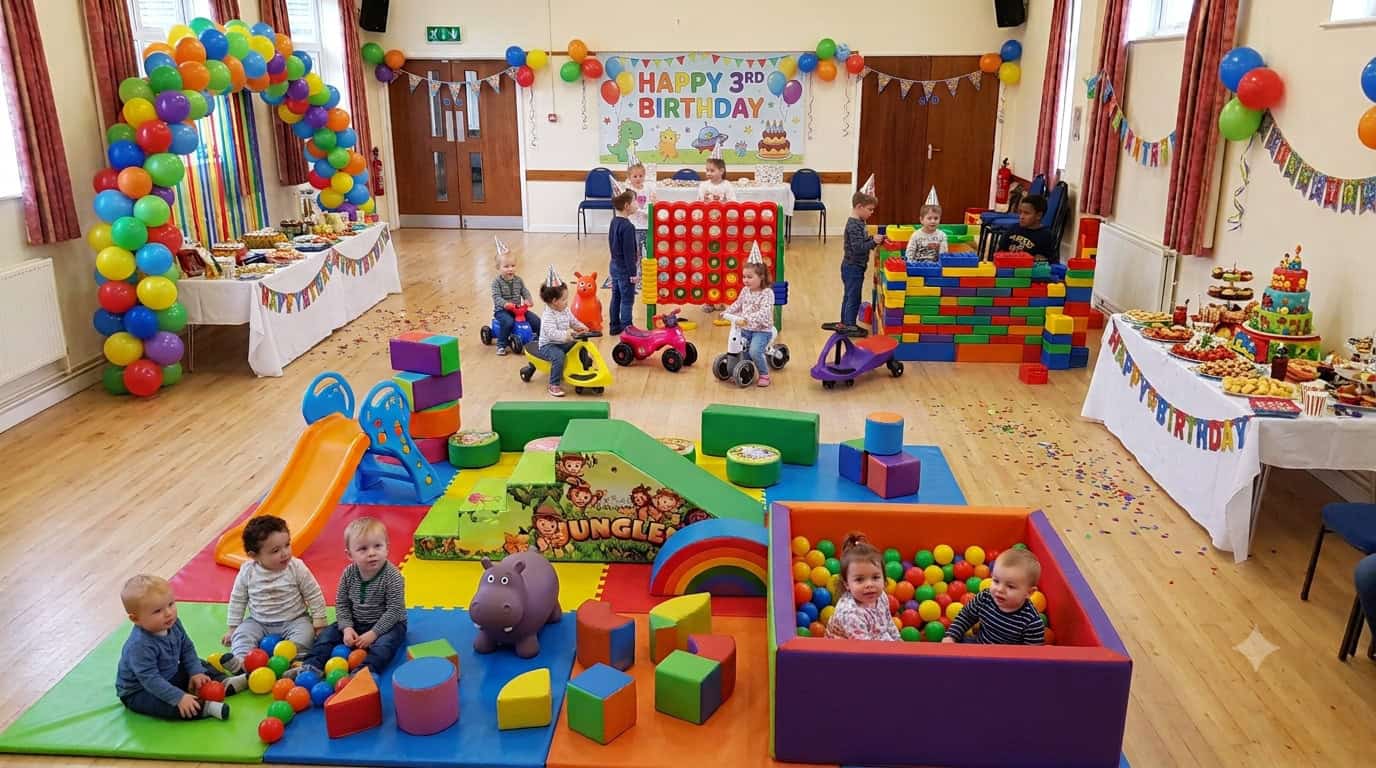
A room full of excited children can turn from wonderfully lively to wildly chaotic in minutes, particularly once the birthday tea is finished. Knowing how to keep children entertained at a party is less about filling every second with planned games and more about creating the right mix of active play, choice, food breaks and calm moments. When children have something suitable to do from the moment they arrive, parents get to relax and enjoy the celebration too.
Start with the children, not the activity list
The best party entertainment depends on who is coming. A two-year-old and an eight-year-old may both love a birthday celebration, but they need very different things from it. Younger children usually enjoy free play, simple movement and familiar toys. Older children are more likely to enjoy a challenge, a team game or the chance to make up their own rules.
Before booking equipment or planning activities, consider the age range, guest numbers, venue and party length. A small living room needs a different approach from a community hall, while an outdoor garden party needs a sensible wet-weather alternative. It also helps to think about the children who may be quieter, younger siblings who are attending, and guests with additional needs. A party feels more inclusive when there is more than one way to join in.
For mixed-age groups, avoid choosing one activity that only suits the oldest children. Create a few simple options instead, so everyone can find their own level of fun without adults having to constantly referee.
How to keep children entertained at a party without over-planning
It is tempting to schedule every minute, especially when you want the party to feel special. In practice, children often need time to settle, explore and play freely. Too many organised games can lead to long waits, disappointment when someone is out, and a room full of children who are being asked to sit still when they would rather move.
A reliable rhythm is to begin with open play while guests arrive, introduce one short group activity once most children are there, pause for food, then offer another active option before cake and collection. That gives the event shape without making it feel like a school timetable.
Keep group games short and forgiving. Musical statues, a treasure hunt, parachute-style games and simple relay challenges can work well, but only if the rules are easy to understand. Choose activities where children can rejoin quickly rather than being eliminated early. The aim is laughter and involvement, not finding a winner.
Create activity zones that give children choice
For many family parties, a few clearly defined play areas work better than one big attraction. Children naturally move between them, which helps prevent queues and keeps the atmosphere relaxed.
A soft play area is ideal for babies, toddlers and younger children who want to climb, crawl and explore at their own pace. It offers a contained place for active play and can be particularly useful in a hired hall where there is otherwise a lot of open space. Make sure the equipment is appropriate for the children’s ages, positioned away from food tables, and supervised by an adult who can spot any over-enthusiastic climbing.
For children who enjoy building and imaginative play, giant building blocks can become anything from a castle to a race track. The beauty of open-ended play is that it lasts longer than a game with one fixed outcome. Children can work together, start again and take ownership of what they make.
Giant garden games are a strong choice for older children, mixed family gatherings and outdoor celebrations. They invite adults and grandparents to join in too, but they need enough clear floor or lawn space to be used safely. In a compact venue, a smaller selection is often more effective than trying to fit in every possible game.
Ride-ons can add excitement for younger guests, provided there is a designated route with no sharp corners, steps or busy food areas. A simple picnic-table area also gives children a place that feels like their own for crafts, snacks or a quieter game away from the main action.
Plan for the moments when energy changes
Children’s energy is rarely steady. They arrive excited, become more confident after a few minutes, then often get hungry or tired just as adults are trying to organise cake. Planning around those changes makes the whole event easier to manage.
Have an activity ready for arrivals, but do not start the main game until enough guests are present. Serve food before children become too hungry to listen. After eating, choose something active rather than asking everyone to sit down again. Save cake, singing and party bags for the final stretch, when a natural gathering point is helpful.
If the party is longer than two hours, think carefully about how much stimulation children can realistically handle. A three-hour celebration may suit a family event with free-flowing play, but a tightly structured three-hour children’s party can feel long. Sometimes a shorter, well-paced party is the happier choice.
Make safety part of the fun
Safe play is what allows children to be confident and adults to enjoy the occasion. Check that hired equipment is thoroughly cleaned, safety-checked and suitable for both the venue and age group. Ask in advance about the space needed, access for delivery, flooring, ceiling height and whether a power point is required.
At the party, keep bags, hot drinks and food away from active play. Create clear boundaries between toddlers and older children where possible, and make sure an adult is responsible for supervising each busy area. Supervision does not mean standing over every child; it means being close enough to step in before rough play, crowding or tiredness becomes a problem.
For outdoor events, check the ground is level and have a back-up plan for rain. For indoor venues, consider how children will move between activities without running through the entrance, kitchen or serving area. A little practical thinking before the guests arrive prevents a great deal of stress later.
Use party hire to reduce the workload
Parents often underestimate how much time is spent collecting toys, transporting bulky equipment, setting it up safely and clearing everything away afterwards. Hiring can make particular sense when you are working with a London venue, limited storage or a party timetable that leaves little room for DIY preparation.
A tailored package can combine age-appropriate play equipment with tables, seating and games that suit the available space. Rather than trying to buy items that may only be used once, you can choose what will genuinely keep your guests engaged. Professional delivery, setup and collection also mean you are not trying to assemble a party while greeting guests at the door.
Kids Rule can help families and organisers choose clean, safety-checked equipment that fits the children, venue and style of celebration. The most useful package is not necessarily the biggest one. It is the one that creates enough variety without overcrowding the room or stretching the budget.
Give adults a role, but not a full-time job
Children enjoy seeing adults take part, whether that means joining a giant game, helping with a treasure clue or admiring a newly built block tower. However, parents and carers should not have to run a constant entertainment programme to keep the party going.
Choose play options children can understand independently, appoint one or two adults to oversee key moments, and let the rest of the grown-ups enjoy a cup of tea and a conversation. If children are safely engaged, the party feels calmer for everyone.
A memorable children’s party does not need non-stop noise or a packed itinerary. Give children room to play, a few exciting choices, somewhere quiet to recharge and adults who are free enough to share the fun. That is usually what turns a good celebration into one families remember warmly.